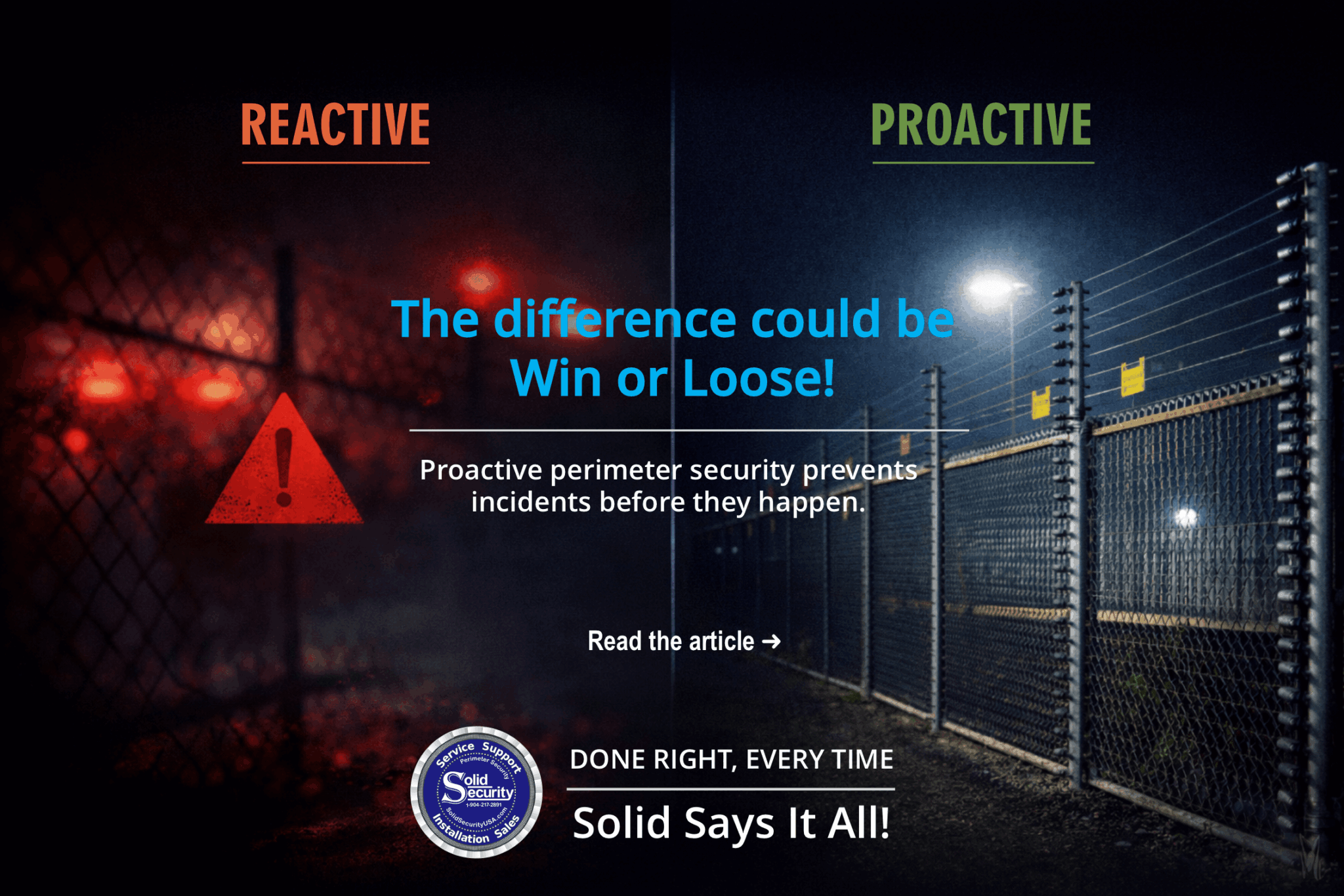
The difference between preventing a security incident and reacting to one often comes down to a single decision: when perimeter protection is put in place.
Organizations that invest in perimeter security solutions only after an incident are forced into hurried decisions, compressed timelines, and higher risk. Perimeter security that has been properly planned, by contrast, is selected and implemented intentionally—before conditions escalate and options narrow, placing the property or facility in a more defensive posture.
That distinction matters more than most organizations realize.
There are three core functions of perimeter protection: Detect, Deter, and Delay. When those elements are missing or underdeveloped, a property becomes what professionals refer to as a “soft target.”
Reactive security: responding after the fact
Reactive security describes what happens during or after an incident when adequate perimeter protection was not in place to prevent it. In this scenario, security teams are forced to respond in real time — containing, managing, and mitigating an active situation rather than stopping it at the boundary.
This form of reactivity often involves:
- Emergency response procedures
- Increased risk to personnel
- Operational disruption
- Limited options under pressure
Once a breach is underway, the perimeter has already failed in its primary role: prevention. At that point, organizations are no longer protecting assets — they are absorbing losses and responding under pressure. The focus shifts from control to damage limitation, where outcomes are harder to predict and manage.
Proactive perimeter security: stopping problems early
Proactive perimeter security solutions are designed to prevent incidents from occurring in the first place. It focuses on detection, deterrence, and controlled response at the outer boundary of a site — before a situation escalates or enters occupied areas.
In a proactive model:
- Threats are identified early
- Response actions are deliberate, not rushed
- Security teams operate with time and information
- Incidents are avoided or neutralized before becoming emergencies
When perimeter protection performs as intended, security is no longer reactive. The site shifts from a soft target to a hard target — one that is designed to discourage intrusion and slow progression long before response is required. Potential threats are addressed as managed events rather than crisis situations.
Why the perimeter is the most critical layer
The perimeter represents the first opportunity to control risk. It is the point where detection is most effective and response options are widest. Once that layer fails, security becomes reactive by default.
Well-designed perimeter systems account for real-world variables—environmental conditions, materials, conductivity, and human behavior—so performance remains reliable outside of ideal test scenarios.
The operational advantage of being proactive
Proactive perimeter security is not about adding more technology. It is about:
- Thoughtful system design
- Proper installation
- Real-world performance testing
- A central command center to monitor
- Ongoing maintenance and evaluation
Organizations that invest in proactive perimeter strategies often experience fewer incidents, lower long-term costs, and more predictable operations. Just as importantly, they avoid the compounded costs that come with installing security after an incident — losses, downtime, and emergency-driven upgrades that far exceed the cost of doing it right the first time.
Turning security into strategy
The strongest security decisions are made before there is a problem to solve. Proactive perimeter security exists to prevent the need for reactive response altogether.
When organizations delay investment until after an incident, they face a different kind of reactivity — rushed purchasing, compressed timelines, and higher costs driven by urgency. Investing early allows perimeter protection to function as intended: stopping problems before they require reaction.
Proactive perimeter security turns prevention into the primary objective, reducing the likelihood that security teams will ever need to respond under crisis conditions.
As many in the industry will say, no one wants to install perimeter security after an incident. At that point, it feels less like planning and more like being forced to fix a problem you didn’t know you had — often at a much higher cost than if the property had been properly secured from the start.
The first step is engaging an experienced team that understands how perimeter security performs in real-world conditions in Commercial Facilities or Correctional Institutions.