Perimeter Solutions for Industrial Facilities
Securing Complex Operations with Tailored Industrial Facilities Perimeter Solutions
Security Imperatives and Targeted Perimeter Solutions for Industrial Facilities
Industrial facilities — from sprawling manufacturing lines and petro-chemical processors to remote storage yards and high-velocity distribution hubs — hold millions of dollars in mobile equipment, metals, and finished goods behind their fences, instantly attracting organized thieves and vandals.
The presence of hazardous chemicals, pressurized systems, and flammable materials elevates any perimeter breach into a potential safety or environmental disaster, demanding strict regulatory oversight. U.S. cargo-theft losses are estimated at $15 billion – $35 billion annually, and roughly one-quarter of recorded incidents occur inside warehouses or distribution yards rather than en route.
Because many plants sit in isolated industrial corridors with limited natural surveillance, they must rely on rugged, layered defences — electrified or anti-ram fencing, pulse intrusion sensors, AI-enabled cameras, vehicle barriers, and credentialled access points — to deliver scalable, 24/7 protection that also satisfies OSHA, CFATS, and insurer requirements.

Page Content Navigation
Identifying the Unique Security Threats Facing Industrial Operations
Focused Perimeter Solutions for Industrial Sites
Deploying Industrial-Grade Perimeter Security
Identifying the Unique Security Threats Facing Industrial Operations
Equipment Theft and Vandalism
Industrial yards are treasure-troves for organized thieves: dozers, loaders, generators, spools of copper, even pallets of catalyst metals are all moveable and easily fenced. When crews strike after hours, they often leave behind wrecked gates, cut power feeds, and production lines frozen until replacements arrive.
Scale of the loss. FBI incident data show almost 12,000 construction-site equipment thefts in 2022, with direct losses estimated between $300 million and $1 billion every year—figures that do not include follow-on costs such as downtime or re-rigging.
Recovery odds are slim. National Equipment Register analysis finds that only about 21 % of stolen heavy equipment is ever recovered, forcing operators to eat the replacement cost and rental premiums.
Copper & commodity raids. The U.S. Department of Energy estimates copper theft alone tops $1 billion annually, with criminals ripping live cable from trays and transformers—often causing fires, arc-flash injuries, and days-long outages.
Collateral damage. Vandals commonly shatter cabs, drain hydraulic lines, or graffiti storage tanks. Beyond the price tag of the stolen goods, plants face OSHA reportables, contract penalties, and slowed throughput that eclipse the original loss.
A single stolen excavator—or 300 ft of stripped copper bus—can idle a production line, derail delivery schedules, and spike insurance premiums overnight. Proactive perimeter detection and rapid-response monitoring are non-negotiable for any industrial facility committed to uptime.
Hazardous-Material Exposure
Industrial sites stock hundreds of tons of acids, solvents, fuels and compressed gases. One intruder—whether a copper thief, disgruntled contractor, or hacktivist—can crack a valve, override a pump, or puncture a line, unleashing toxic plumes or runaway fires while plant staff scramble to respond.
Regulatory trip-wire. OSHA’s HAZWOPER directive makes it clear that “emergency response operations for releases of, or substantial threats of releases of, hazardous substances” fall under 29 CFR 1910.120(q)—no matter where the release occurs. Facilities must plan and train for these scenarios.
Gatekeeping is mandatory. The Process Safety Management standard (29 CFR 1910.119) requires employers to install “effective measures to prevent unauthorized entry” into areas containing highly hazardous chemicals—think dual-factor access control, perimeter fencing, and 24/7 monitoring.
Penalties bite hard. As of January 15 2025, OSHA can levy up to $165,514 per willful or repeated violation, with serious violations now $16,550 each. A single breach that causes a release can rack up multiple counts.
True cost can be greater than the fine. Cleanup, EPA reporting, community evacuations, and weeks of lost production frequently snowball into multi-million-dollar hits—plus repetitional damage that can linger for years.
Perimeter security isn’t just asset protection; it’s a frontline safety control that keeps hazardous chemicals where they belong and your operation on the right side of OSHA.
Industrial Espionage
Theft today isn’t limited to tools you can lift off the yard. Competitors and nation-states are actively hunting the CAD files, process logic, and trade secrets that give your plant its edge.
Physical heists of “unstealable” tech. In 2019 investigators discovered Chinese divers had literally cut a piece of a U.S. telecom’s new subsea-cable device off the ocean floor, brought it home, and reverse-engineered it—showing that even hardware buried 3 miles down is fair game.
Leapfrogging by copying, not R&D. Vanity Fair’s technology sources warn that years of IP theft have let rivals “leapfrog the United States”—especially in 5G and advanced electronics—compressing a decade of product development into months.
Insiders on the payroll. Espionage increasingly looks like a summer intern: in one Silicon Valley case, a student hire was caught exfiltrating server data via malware to dozens of computers in China.
Cheaper than innovation. As Vanity Fair bluntly notes, foreign actors can “save billions of dollars in R&D” by slipping a mole inside and siphoning designs for the cost of an airline ticket—then selling your product before you do.
A breached design lab can be as crippling as a sabotaged pump room—every proprietary blueprint lost today funds your next global competitor tomorrow.
Remote Locations & Limited Natural Surveillance
Industrial plants are often miles from the nearest population center, ring-fenced by scrubland, rail spurs, or tank farms. After the day shift clocks out, a single breach can go unseen for crucial minutes—time a thief, saboteur, or fire only needs to escalate from nuisance to disaster.
Longer emergency arrivals—sometimes double. In predominantly rural states, 24 % of EMS providers report average on-scene times of 9-12 minutes, versus a 6-minute statewide mean—and that’s just medical response, not full police or fire suppression.
Thinly staffed patrols & “geographic isolation.” Small and rural law-enforcement agencies cite “long travel distances for response” and chronic budget gaps that keep patrol coverage light after dark.
No eyes on the fence line. Security consultants note that isolation and limited nearby law-enforcement support mean intruders can cut through or scale fencing “with delayed response times, increasing the potential for damage or loss.”
Compounded costs. Every extra minute before boots arrive expands the crime scene—more copper stripped, more fuel siphoned, more downtime to investigate, repair, and restart production.
Distance is the intruder’s best accomplice. Industrial facilities in remote settings must replace absent “natural surveillance” with real-time detection—monitored pulse fencing, perimeter cameras, and rapid-dispatch protocols—to keep response windows measured in seconds, not miles.
Regulatory Compliance
Missing or non-compliant perimeter measures can turn a security lapse into a regulatory fiasco. Three core rule-sets dictate how an industrial fence line is built, marked, and managed:
OSHA — Process Safety + Hazard Signage. Under 29 CFR 1910.119 (Process Safety Management), companies handling threshold quantities of highly hazardous chemicals must “establish and implement procedures to secure the process and prevent unauthorized entry.” Meanwhile 29 CFR 1910.145 spells out danger/caution sign specs—letter height, colors, placement—required on gates, energized enclosures, and any fence section where workers could face chemical or electrical hazards.
CFATS — Perimeter & Access Standards. DHS’s Chemical Facility Anti-Terrorism Standards compel high-risk sites to meet Risk-Based Performance Standard 1 “Restrict Area Perimeter,” RBPS 2 “Secure Site Assets,” and RBPS 3 “Screen and Control Access.” Acceptable solutions include anti-climb fencing, monitored pulse barriers, controlled vehicle gates, and credentialed turnstiles.
NFPA 70E — Electrical Hazard Boundaries & Warnings. Article 130.7(E)(2) requires barricades or fencing no closer than the arc-flash boundary and mandates conspicuous warning signage to keep unqualified personnel beyond the limited-approach boundary—directly influencing fence offsets and placard layouts around switchyards and MCC buildings.
Compliance isn’t a paperwork exercise; it dictates fence height, grounding, signage fonts, and even how far a gate must sit from an energized yard. Skipping these details risks OSHA fines, DHS enforcement actions, and NFPA safety violations—plus the operational chaos that follows.
Focused Perimeter Solutions for Industrial Sites
Engineered Perimeter Defenses
Industrial sites can’t rely on a single barrier. A layered toolkit—physical, electronic, and cyber is needed—that spots a breach the moment it starts, slows an intruder’s progress, and routes clear, actionable alarms to the right responders. The elements below work together to close every gap: stopping vehicles before they ram a tank farm gate, flagging a lone prowler at 2 a.m., or isolating a rogue USB stick from your process network.
Monitored Pulse Fence
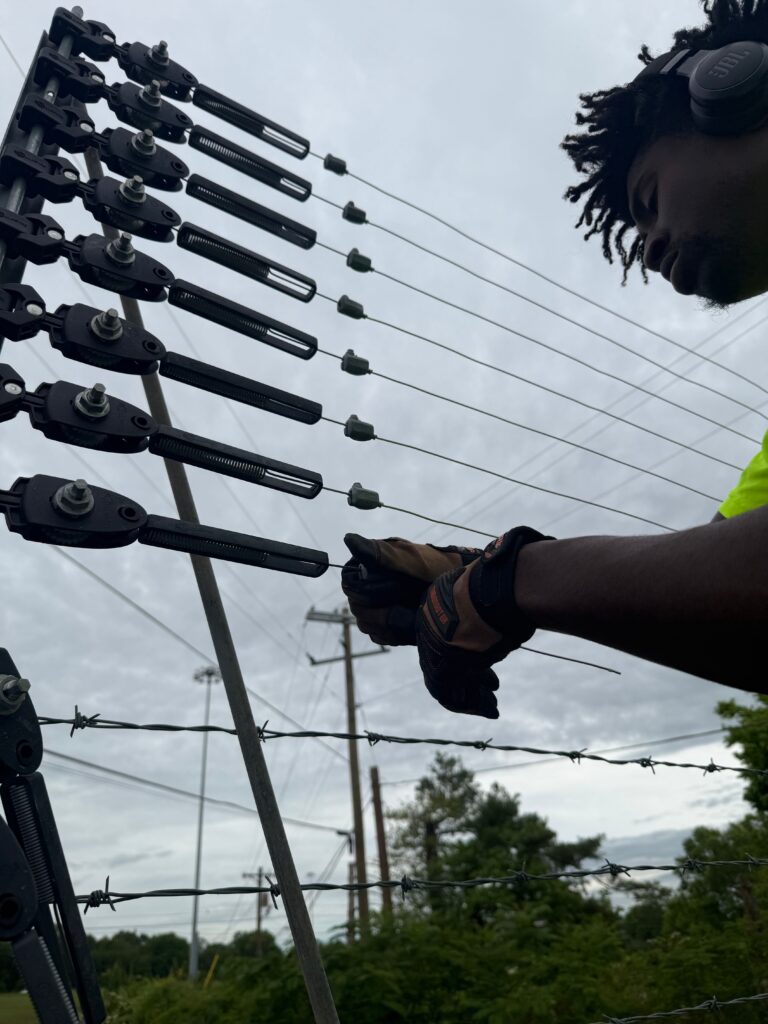
A passive fence only marks the boundary; a Gallagher monitored-pulse fence turns that wire into an intelligent trip-wire that raises an alarm the very first pulse cycle (≈1 second) after it’s touched, cut, or shorted. Here’s what that looks like on an industrial perimeter:
Instant cut-and-climb alarms. Gallagher F-Series Fence Controllers fire a regulated high-voltage pulse once each second; if the return path is interrupted, the controller immediately signals Command Centre and local strobes/sirens—no waiting for a guard tour.
Live, non-lethal deterrence. Dual-pulse mode delivers up to 16 kV peak for maximum after-hours punch, yet meets every international safety standard. Intruders get a sharp, memorable shock that stops the climb without causing injury.
Zone-level incident location. Z-series sensors (Z10 Tension, Z20 Disturbance) and Gallagher’s HBUS network break the fence into addressable zones; Command Centre pin-points which span was hit and automatically slews PTZ cameras to the right spot.
Covers the blind spots cameras miss. Vibration and tension sensors “feel” a hacksaw, bolt-cutter, or ladder on the wire, giving you reliable detection even in fog, smoke, or dead-ground corners.
Scales to hundreds of kilometres. Gallagher hardware is designed for sites with “100’s of kilometers of fence line,” yet remains manageable from a single controller stack.
Built-in health & compliance monitoring. The 3-Zone Fence Integrity Monitor (FIM) provides continuous ‘cut-wire’ and short-circuit detection, pushes maintenance alerts, and produces reports that keep OSHA, CFATS, and NFPA-70E auditors happy.
Thinking about a Gallagher monitored electric fence?
Make a call to Solid Security to start the conversation for your project — get site-specific layouts, ROI modeling, and a compliance checklist tailored to your facility.
High-Security & Anti-Ram Fencing
Industrial yards need a barrier that can stop a five-ton pickup at 50 mph and still keep a climber from getting finger purchase:
Anti-climb mesh. 10-foot-high, 8-gauge 358 mesh (“prison mesh”) leaves only 76 × 12 mm openings—too tight for boot tips or bolt-cutters—and is now offered in a groundable version for substation or refinery use.
Crash-rated gates & barriers. Your vehicle gates and fixed bollards should be tested to the new ASTM F2656/F2656M-23 standard; an M50-P1 rating means the fence stops a 15,000-lb truck at 50 mph with ≤1 m of penetration. DoD’s September 2024 anti-ram list adopts these ratings across the board.
Razor-wire toppers. Concertina or flat-wrap razor wire adds an overt deterrent; security consultancies note its “menacing appearance” alone cuts intrusion attempts by double-digit percentages in remote industrial zones.
Crash-rated structures shield tank farms from vehicle-borne saboteurs, anti-climb mesh denies ladders and hand-holds, and razor wire delivers the visual “no-go” cue that keeps opportunistic thieves looking elsewhere—all while satisfying CFATS RBPS 1-3 perimeter requirements.
CCTV with AI Analytics
Video surveillance is still the fastest way to see what tripped the fence alarm, but today’s cameras do much more than stream footage: on-board deep-learning chips now detect, classify, and verify a threat before a human ever looks at a monitor.
Thermal + PTZ coverage in any light. Perimeter cameras with dual-sensor (thermal / visible) heads and 30 × zoom track people or vehicles hundreds of metres out, day or night, then hand-off automatically to a PTZ for close-up ID—a workflow Security Today cites as a best practice for reducing guard workload.
AI cuts false alarms. Object-based analytics ignore waving trees and stray animals, flagging only humans, vehicles or licence plates; Security Today notes the approach “minimises storage and bandwidth while keeping operators focused on real events.”
Real-time event verification. Edge analytics push a 10-second clip to the VMS within ~20 s of detection, letting staff speak through loud-hailers or dispatch responders faster—an efficiency gain highlighted in the 2025 article Creating More Versatility.
Loitering, perimeter-testing, and tail-gate rules. Pre-built AI models watch for dwell time, ladder approaches, or vehicles reversing toward a gate, sending colour-coded alerts that integrate with Gallagher Command Centre or any ONVIF-compliant VMS.
Licence plate and container ID recognition. Cameras tag inbound trucks long before they reach the dock, giving security a head-start on vetting credentials and spotting unauthorised returns.
Smart thermal and PTZ cameras act as automated, weather-proof sentries—verifying the alarm, cueing other sensors, and delivering a live, forensic-ready clip to the control room before the intruder makes it past the fence.
Access Control & Credentialing
Controlling who crosses from the outer yard into live process areas is as critical as fortifying the fence itself. A layered access-control stack lets you grant or revoke privileges in seconds while keeping an auditable record for OSHA and CFATS inspectors.
- Unified credential ecosystem. Gallagher Command Centre ties together traditional DESFire® smart-cards, the Gallagher Mobile Connect app (Bluetooth/NFC credentials on iOS / Android), and third-party biometrics—so an operator can badge a phone at the turnstile, then present a fingerprint or iris at the control-room door without juggling multiple systems.
- Zone-based permissions & instant lockdown. Rulesets restrict contractors to maintenance corridors while giving engineers 24 × 7 access to MCC rooms; a single click in Command Centre can “lock down” any zone for an emergency muster.
- Crash-rated vehicle barriers. Integrated swing/slide gates and M30/M50 wedge barriers open only after the driver’s plate, RFID tag, or mobile credential is validated—stopping tail-gaters and eliminating manual guard checks.
- Real-time compliance trail. Every credential swipe, biometric match, or gate cycle is time-stamped and stored, producing exportable reports that satisfy 29 CFR 1910.119 (Process Safety Management) and DHS RBPS 3 “Screen and Control Access.”
- Visitor & contractor onboarding in minutes. Pre-enroll credentials before arrival; temporary QR or mobile passes expire automatically at shift’s end, slashing the paperwork bottleneck at the guard shack.
By merging biometrics, mobile IDs, and high-speed vehicle barriers into one command platform, industrial facilities turn access control from a patchwork of padlocks into a real-time, data-driven safety system that keeps the wrong people—and vehicles—out of your critical process zones.
Lighting & Clear Signage
Night-time is when thieves count on darkness and confusion. A modern industrial-grade lighting plan flips that advantage: perimeter LEDs blaze on cue, signage tells intruders exactly what risks they face, and the whole system feeds actionable video to the control room.
Uniform LED “light curtains” around the fence line. Following IES RP-7-21 guidance, plants aim for 5-10 lux along open yards and perimeter strips—bright enough for cameras, dim enough to curb glare and energy waste.
Motion-activated flood & strobe response. Hybrid systems such as the Senstar LM100 combine fence-mounted LEDs with vibration sensors; when a panel is touched, the fixture instantly ramps to full output and notifies the VMS—Security Magazine calls it a “powerful deterrent at the fence line.”
Cuts the dark-site burglary rate. Case studies show three out of four commercial burglaries strike properties that lack adequate security lighting; adding continuous or standby LED lines slashes those numbers.
Integrates with AI CCTV. Consistent LED colour temperature lets thermal/visible cameras maintain detection accuracy, while smart drivers flash or dim on command—to highlight a fence breach the instant analytics flag loitering.
OSHA-compliant danger & caution signage. Under 29 CFR 1910.145, red/black/white DANGER placards and yellow/black CAUTION signs must be posted where energized lines, high voltage, or hazardous chemicals sit behind a fence—lighting ensures those warnings remain legible after dusk.
Well-designed LED lines and code-correct signage turn darkness into daylight, give cameras perfect visibility, and deliver a psychological message thieves can’t miss: “You’ve been seen—move on.”
Cyber-Physical Safeguards
Modern industrial security is as much about packets as it is about padlocks. A fence breach is bad; a PLC hijack that flips a pump or opens a valve is worse—and attackers increasingly chain the two. Solid Security designs every monitored-pulse deployment to plug straight into a hardened network core built on three principles:
- IT/OT network segmentation. Process-control VLANs live behind a DMZ firewall or data diode, separated from corporate email and Internet traffic. When Russian grid probes highlighted these gaps, US regulators singled out network segmentation as a top defense against lateral movement in critical infrastructure.
- Mandatory multi-factor authentication (MFA). Gallagher Command Centre now supports FIDO2 keys and mobile push; operators must “tap + approve” before they can silence an alarm, open a gate, or view camera feeds. High-profile breaches in 2024 showed that simply leaving 2FA off was enough for attackers to walk into cloud consoles and steal terabytes of data.
- Role-based least privilege. Contractors get time-boxed accounts limited to their work orders; engineers see only the PLC racks they maintain; security admins cannot touch production logic, and vice-versa.
- Encrypted field bus & fence controllers. Gallagher HBUS devices negotiate TLS 1.3 tunnels back to the controller—no clear-text serial lines for intruders to sniff or spoof.
- Continuous patch & vulnerability management. Weekly scans of Windows HMIs and monthly firmware checks on energizers close the window between disclosure and exploit.
- Real-time OT/IT correlation. A fence-line voltage drop, a failed MFA attempt on a gate server, and a sudden Modbus write to “pump-01” all hit the SIEM as one correlated event—so the response team sees the full kill-chain, not disconnected alerts.
Segmentation keeps malware from riding a stolen badge into your PLC network, and MFA stops attackers from logging in even if they phish a password. Together they turn your Gallagher-driven perimeter into a true cyber-physical shield—one that plays by NERC CIP, CFATS, and Zero-Trust rules without slowing production.
Drone-Detection Layer
Cheap quad-copters have become the new bolt-cutters: they slip over the fence to scout layouts, drop contraband, or carry Wi-Fi sniffers that hunt for open OT access points. Industry analysts rank espionage and sabotage by drones in the top-five threats for 2025, forcing plants to extend their perimeter upward.
RF direction-finding arrays. Multi-antenna sensors (e.g., Dedrone RF-160) scan controller frequencies and triangulate both the drone and its pilot in real time—critical intel for law-enforcement hand-off.
3-D low-slow-small radar. Electronic-scanning ground radars such as Blighter A800 track hobby drones out to 3 km, day or night, through rain or dust—covering autonomous craft that give no RF signature.
Auto-cued PTZ/thermal cameras. When radar or RF flags an object, the VMS slews a long-range PTZ to lock on, capturing evidentiary video and confirming payload type before you escalate.
Gallagher Command Centre integration. Counter-UAS partners feed their detection tracks into Command Centre zones; the moment a drone violates the geofence, alarms, strobes, and even pulse-fence voltage can be elevated automatically.
Layered countermeasures. Policy-based responses range from siren / light deterrence to handheld RF disruptors (where legally permitted) that force a return-to-home or controlled landing.
Regulatory compliance & audit trail. Every detection and response is time-stamped and logged, satisfying DHS Counter-UAS guidance and demonstrating due diligence to insurers.
A fence can’t stop what flies—radar and RF sensors close that gap, feeding actionable airspace data straight into the same Gallagher console that watches your gates and pulse fence.
Emergency-Response Integration
A breach is measured in seconds; the faster an alarm reaches responders, the smaller the incident. Gallagher’s platform and current code updates let perimeter events flow straight from the fence energizer to every critical node—on-site Emergency Response Team (ERT), local 911/PSAP, and even national alerting networks.
One event, many channels. When a monitored-pulse controller trips, Gallagher Command Centre fan-outs the alert as pop-ups, SMS, email, and push to the Command Centre Mobile app—no operator action required.
NFPA 72-2025 mass-notification ready. The new code explicitly permits security alarms to auto-activate facility voice, strobes, and public-address systems—tying the fence line into the same life-safety backbone that handles fire and haz-mat evacuations.
Direct link to municipal dispatch. Gateways using FEMA’s IPAWS or the FCC’s Emergency Alert System (EAS) forward verified alarms to county 911 consoles, shaving minutes off the call-out.
Macro-driven site controls. Alarm rules can auto-unlock muster doors, freeze badge readers, or boost fence voltage while scrolling ERT instructions on in-plant HMI screens—turning alerts into immediate containment actions.
Full audit trail for regulators. Every notification hop—energizer, Command Centre, PA system, IPAWS push—is time-stamped and archived, creating the documentation OSHA and DHS inspectors ask for after an incident.
By wiring your monitored pulse fence directly into NFPA-compliant mass-notification and first-responder networks, you collapse the response window from “someone call 911” to an automated, seconds-long dispatch loop—often before an intruder’s feet hit the ground.
Deploying Industrial-Grade Perimeter Security
From Risk Map to Resilience: This is the blueprint that turns a fence plan into day-one protection.
Industrial facilities can’t just bolt on cameras and call it secure. The process starts with a data-driven risk assessment that charts outside threats, insider pathways, vehicle vectors, and regulatory gaps; Security Today calls this the first “guiding principle” of modern perimeter defense.
- Comprehensive risk assessment – map threats, insider risks, vehicle vectors, and regulatory gaps.
- Zone-based design – segment large grounds for precise alarm location and faster response.
- Phased installation – minimize downtime while upgrading critical areas first.
- Staff training & insider-threat awareness – drills on breach, haz-mat release, and evacuation scenarios.
- Preventive maintenance & 24 / 7 monitoring – health-checks, firmware updates, and guaranteed SLA response keep systems reliable.
Those findings drive a zone-based design so alarms fire only where the breach occurs, not across two miles of wire. Upgrades roll out in phased installations that shield critical assets first and keep production running. Staff drills and insider-threat awareness make sure the people factor isn’t the weak link. Finally, preventive maintenance and 24/7 health monitoring lock in reliability—something OSHA explicitly lists as a duty for employers operating safety-critical systems.
Contact Solid Security Today to Get Started
Safeguarding your commercial facility requires a proactive and comprehensive approach. By conducting regular security assessments, providing ongoing employee training, and collaborating with seasoned security professionals, you can establish a robust perimeter security system tailored to your organization’s unique needs. Don’t wait for a security breach to occur—take action now to protect your assets, employees, and customers.

Solutions for Industrial Facilities FAQ's
What exactly is a “monitored pulse” fence and how is it safer than a traditional electric fence?
Gallagher’s monitored-pulse fence sends a brief, high-voltage pulse once per second. If a wire is touched, cut, or shorted, the controller raises an alarm instantly while delivering a non-lethal shock that meets international safety standards (IEC 60335-2-76). Unlike a conventional electric fence, it provides precise, zone-level intrusion data to CCTV and access-control systems.
How fast will we know there’s a breach, and can we locate it accurately on a two-mile fence?
Cut-climb events trigger in ≤ 1 second. Fence zones or vibration cables localise the breach to within 1 metre, cueing PTZ cameras to the exact span so responders are dispatched to the right gate—not searching the entire perimeter.
How does a monitored-pulse fence differ from a conventional electric fence?
A monitored-pulse fence energises the wires and measures circuit integrity every second; any touch, cut, or short immediately raises an alarm and pin-points the zone. Traditional electric fences deliver a shock but provide no detection or location data.
What techniques localise an intrusion along multi-kilometre fence runs?
Segmenting the fence into addressable zones with tension, vibration, or fiber sensors lets the control platform report the breach to within a metre and auto-cue nearby PTZ cameras.
How can installation proceed without halting production?
Use a phased approach: secure the highest-risk zones first, schedule gate work during planned downtime, and commission fence sections one at a time while traffic is rerouted.
What countermeasures address drone incursions above the fence line?
A layered solution of RF-direction-finding receivers, low-slow-small radar, and auto-cued PTZ/thermal cameras detects drones and, where permitted, can trigger strobes, sirens, or RF disruptors.
How often should preventive maintenance be performed on perimeter equipment?
Best practice is a monthly check of energiser voltage, sensor continuity, camera focus, and firmware versions, coupled with 24 / 7 health polling that auto-generates service tickets for any fault.